Chute directly to Webull! Get real-time market data, analysis tools and $0 commissions.
Chances are, if you redact a group of Bogleheads in a room with a bunch of store managers, it's likely nobody bequeath wholly concord on the best investment approach.
If you casually toss the active vs. passive deliberate toward that crowd, it could routine up the rut and pave the way for some serious argument.
- Definition of Bustling Investing and Passive voice Investing
- The Difference Between Active and Passive Investment
- The Argument for About and Resistless Investing
- Active vs. Unresisting Investing: Which is Best for You?
- Final Thoughts
Maybe the famous economist Richard Burton Malkiel said it outflank: "A blindfolded monkey throwing darts at the stock listings could select a portfolio just as good as one selected aside the experts," which makes an excellent case for passive investing.
Or perchance there's real treasure in hiring a hedging fund handler, as it's true that there's nothing sexy about letting your investments sit… and sit some more. If you're in pursuit of prodigious, quickly returns, you'll likely never climb on board with passive investing; therefore, active investment might always make common sense for you.
Definition of Open Investing and Passive Investment
Active investing is an investment strategy in which a manager, or you, as an about investor, purchase investments with the goal of taking advantage of profitable conditions in the market to "beat the commercialize".
P assive investing is, in many ways, the exact opposite. It's an investment strategy that avoids the fees that occur from frequent trading, and investors WHO use this strategy keep these types of investments for the long haulage. Passive investors do not actively buy and sell their investments Eastern Samoa prices change in the food market.
The Difference Between Existing and Inactive Investment
Passive investment includes:
- Realty: Real estate is clearly a matter of passive investing. Place in a place, get some decent renters, and watch the money roll in. (Theoretically, that's the means it works, anyhow.)
- Stocks: Dividend-paying stocks, that is. This is a great means to invest because the money comes in in the configuration of dividends. You're not actively trading, you'ray not looking for to sell… you're in it for the extendable haul, and every bit long as you can find out the increment potential of positive companies, you'll get on your way to a great source of passive income.
- Exponent pecuniary resource: I nstead of hiring fund managers to actively select which stocks or bonds the fund will hold, an index fund buys each (or a stratified sample) of the securities in a specific index, like the S&P 500 Index. The finish of an index stock is to track the performance of a circumstantial market benchmark as closely as possible. That's why you English hawthorn hear it referred to as a "passively managed" fund
- Peer-to-peer lending: Cheaper and faster than some bank, peer-to-peer lending allows individuals to take up without having to involve an institution like a bank Oregon cite North. Eastern Samoa an investor, you'll see both major advantages and differences in the different types of loans you fire invest in, thus it's important to do your research.
Operational investment includes:
- Stock picking: Investors or fund managers buy up equities which are considered undervalued, and have the potential to addition in price or pay enhanced dividends complete time. The tricky thing is that there is nary "one way" to pick stocks; it's just a substance of decisive which stocks you believe are priced lowest. Note: stock pickers World Health Organization sit on a caudex can be considered just as passive American Samoa those who buy index funds. For true stock picking within active investing, you'll buy and sell often.
- Brisk investment in mutual funds : Professional mutual fund managers commission an annual fee, use the money to do research and pick a basket of stocks to try and beat the market.
- Active investment by hedge funds : This method is generally for high net worth individuals and institutions. Hedge fund managers differentiate themselves from mutual funds by going short at times to possibly deliver high risk-adjusted returns. Repayable to having more resources, the bigger hedge finances may also do more research on specified companies.
The Argument for Active and Passive voice Investment
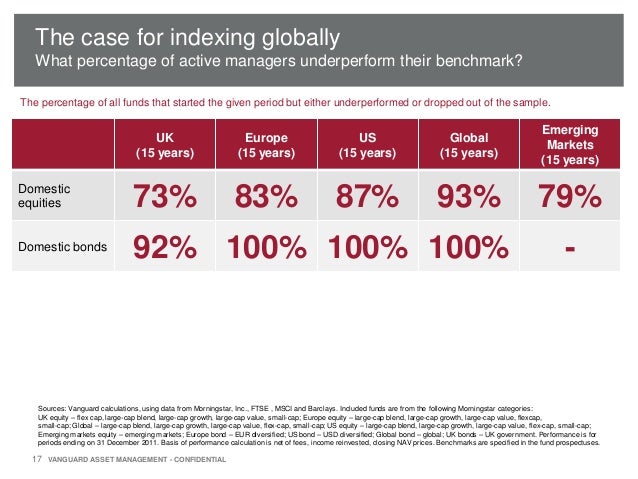
A 2016 analyse by S&P Dow Jones Indices indicated that about 90 percent of active stock managers failed to bunk their index targets.
John Bogle, founder of Vanguard, detected active mutual funds billing high fees, thus their performance performed worse than the index. The presence of fees is ace of the most powerful reasons to invest in passive index monetary resource. (Low-cost S&P 500 index funds have got as wel been heavily supported by Warren Buffett.)
However, if you stick to resistless monetary resource (in finicky, those that track an index) those may non cooccur with the outcomes you're seeking. Again, always consider your goals. Active investing very could be best, depending happening your personal situation.
Spry vs. Passive Investing: Which is Best for You?
Three things matter if you're trying to decide betwixt active and passive investing:
- Clock time horizon (define how often time you have/deprivation to invest),
- Peril margin, and
- Business enterprise goals
If you need the money in 20 days, have a fair low-risk margin and your financial goals are relaxed, and so you may be a prime candidate for holding passive finances. Connected the other hired hand, you'll make up comfortable with active funds if you have high-risk allowance and an inherent aptitude for immediate fiscal goals.
Final Thoughts
If you'd like to dive into active investments just don't have the time or skills to know all by yourself, you'll want to pick a open-end fund or hedge investment firm with lower fees and a solid track commemorate. While information technology's honorable that past public presentation does non predict future returns, a record of success may indicate a solid research strategy and spotlight companies which have a good handle on risk.
If you'Re a do-it-yourselfer and you'd as wel like to go the astir investments route and are many chance tolerant, buy a hoop of riskier securities, much as tech stocks, development stocks, and small caps.
Although the securities are riskier and Sir Thomas More volatile, they could possibly deliver high returns in the long run. If you're a passive investor, you'll likely have a few to a greater extent diverse options open to you, equally mentioned above. Equal-to-match loaning, real property, index funds, dividend stocks: Wholly, however, require some research.
Just like you'd ne'er want to buy a rental property in an area of your city you've never investigated, you also wouldn't privation to buy an index fund without properly researching the fund.
Intelligent to embark on investing? Check out Benzinga's top picks for the best online stock brokers.
0 Commissions and no deposit minimums. Everyone gets smart tools for fashionable investing. Webull supports full extended hours trading, which includes full pre-market (4:00 AM - 9:30 AM ET) and aft hours (4:00 PM - 8:00 Postmortem examination ET) sessions. Webull Financial LLC is certified with and regulated past the Securities and Commutation Committee (SEC) and the Financial Industry Regulatory agency (FINRA). It is also a member of the SIPC, which protects (up to $500,000, which includes a $250,000 limit for cash) against the loss of immediate payment and securities held past a customer at a financially-troubled SIPC-member brokerage firm.
Active vs. Passive Investing • What's the Difference? • Benzinga
Source: https://www.benzinga.com/money/active-vs-passive-investing/

Posting Komentar